There is no ban and no new rules for 2026, so the things that matter most this winter are dry, seasoned logs, a well-kept stove and the Smoke Control Area rules that already apply.
There is no wood burner ban, and for households in Leicestershire stocking up on logs for the colder months, nothing announced so far changes how you can heat your home with a stove or open fire. In its advice for stove owners, HETAS puts it plainly: “Labour is not banning wood burners and there are no new wood burner rules for 2026.”
The question keeps coming up because the government’s Environmental Improvement Plan 2025 set tougher targets for fine particles in the air. Defra then ran a UK-wide consultation on solid fuel burning between 22 January and 19 March 2026. For most homeowners, the rules that already apply matter far more this winter than the headlines. Those rules are about dry fuel, a well-maintained appliance and Smoke Control Areas. Get those right and you are in a good position, whatever the consultation leads to.
Could wood burners be banned later on?
Nothing published so far points that way. The Environmental Improvement Plan 2025 (often shortened to EIP25) is the UK Government’s strategy for tackling environmental issues, including air pollution, restoring nature and improving public health. HETAS notes that a ban is not mentioned in it.
The plan proposes no changes to Smoke Control Areas, to enforcement powers or to emissions limits. On home burning, its commitment is to consult in 2026 on measures to further reduce emissions from domestic combustion. That is a promise to gather views, not a decision. When the plan came out, HETAS pointed out that the details of that consultation had not yet been released.
Why the government is looking at home burning
The interest comes from air quality targets. Under the plan, England aims to bring the average level of PM2.5 in the air down to 10µg/m³ by 2030, ten years earlier than previously planned. A second target covers how much pollution people actually breathe. Average exposure across the whole population is to fall by 30% compared with 2018 levels by 2030, and by 35% by 2040.
PM2.5 is the name for very fine particles in the air. Defra describes them as tiny particles that can enter the lungs and bloodstream, and links them to conditions such as heart disease and asthma, as well as premature death. Children, older people and those with existing health conditions are the groups most affected. Defra calls air pollution one of the largest environmental risks to human health and puts its estimated annual cost to society at £20 billion.
Home burning is one of the areas the plan concentrates on. In the plan’s terms that covers wood burners, open fireplaces, barbecues, bonfires and other unregulated outdoor burning. Transport and industry are the other main sources it names, and each has its own targeted strategy. According to Defra, burning wood and manufactured solid fuels at home accounted for around 20% of the UK’s total PM2.5 emissions in 2023, a similar share to road transport.
The longer view is more encouraging than that figure might suggest. HETAS reports that PM2.5 from domestic combustion fell by 17% between 2020 and 2023, and that overall UK PM2.5 emissions are down 76% since 1990. Defra reads recent years a little differently. It says emissions from home burning have risen as stoves have grown more popular, even though air quality has improved overall. Both bodies are describing the same aim, which is cleaner fires in homes that keep using them.
What the Defra consultation proposed
The Defra consultation on solid fuel burning put forward stricter emission limits for new stoves, meaning tougher smoke standards for appliances placed on the market. It also proposed mandatory labelling for stoves and fuels, giving information on emissions, permitted fuels and health impacts. Its last main proposal was increased enforcement penalties for suppliers who breach fuel standards.
Labelling, if it goes ahead, could make it easier for households to see what they are buying and which fuels suit their appliance.
The consultation was UK-wide. Defra ran it with the Scottish Government, the Welsh Government and DAERA in Northern Ireland, and any further action will be developed alongside the devolved governments. The consultation documents were published in English and Welsh in January 2026, together with a Domestic Burning De Minimis Assessment. Responses received by 19 March 2026 will be analysed and taken into account by all UK Governments. A summary of responses will be published on the government website, with an annex listing responding organisations and the part of the UK they represent, but no personal names or contact details. No emission limit values, penalty sizes or timelines have been given, so anyone predicting exactly what will change, or when, is guessing.
The rules that already apply: Smoke Control Areas
Smoke Control Areas have existed across the UK for decades. Inside one, emitting smoke from a chimney is an offence, and councils can issue civil penalties to repeat offenders if smoke is persistently emitted. Your local council can tell you whether your address falls within one.
Being in a Smoke Control Area affects which appliances and fuels you can use there. HETAS says stoves certified under its Cleaner Choice scheme emit at least 50% less PM2.5 than Smoke Control Area limits legally require. That gives a comfortable margin if you are choosing a new stove and want to be confident it will stay within the rules.
What this means for the logs you burn
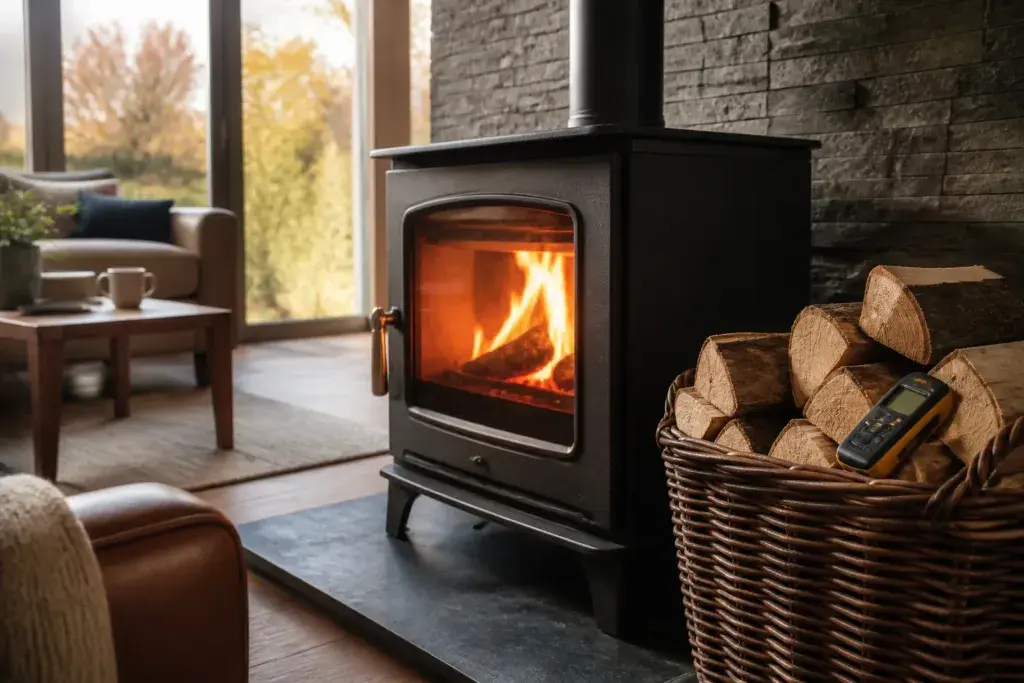
This is where most households can make a real difference. HETAS advises stove owners to start by checking their stove model, so they know how it performs and which fuels suit it. Fuel should carry the Ready to Burn logo, and any firewood you have collected yourself is worth checking with a moisture meter before it goes on the fire. HETAS also recommends booking a chimney sweep and annual maintenance for the appliance, and burning responsibly.
Freshly felled timber, or branches gathered after a storm, can hold a lot of water. A fire fed with wet logs usually spends much of its energy boiling that water off. That tends to mean more smoke, a sooty glass door and less warmth in the room.
Properly seasoned firewood, left to dry until its moisture has dropped, generally burns hotter and cleaner. In practice that could mean fewer logs for the same heat, which helps when winter bills are already stretching the household budget. A moisture meter is inexpensive and takes the guesswork out of it, particularly for wood you have cut or been given yourself.
Skipping the annual sweep is the other easy slip. A well-maintained flue and stove are more likely to draw properly and burn efficiently, and a sweep can pick up small problems before they grow.
If you still use an open fire, it may be worth thinking about the longer term. HETAS says a Cleaner Choice certified stove can emit up to 90% less PM2.5 than an open fire. Plenty of people love their fireplace and will keep using it, and dry logs will help it burn as cleanly as it can. For anyone already weighing up an upgrade, a certified stove could make a difference to both emissions and how far each delivery of logs goes.
Keeping your fire burning cleanly this winter
The national targets are ambitious, and the consultation shows the government wants cleaner appliances, clearer labelling and better fuel. For households, that matches good practice that has applied for years.
The message is simple: burn only properly seasoned or Ready to Burn logs, have your chimney swept and your stove serviced every year, and check with your council whether your address sits in a Smoke Control Area. National targets may be set in Whitehall, but the same practical principles apply at your own hearth.
If you would like to talk through seasoned firewood for your stove or open fire, the Harbour Tree Care team in Leicestershire is always happy to help.