If you want a tree made smaller rather than taken down, here is what crown reduction involves, why thinning and lifting won't reduce height, and what to check before any pruning starts.
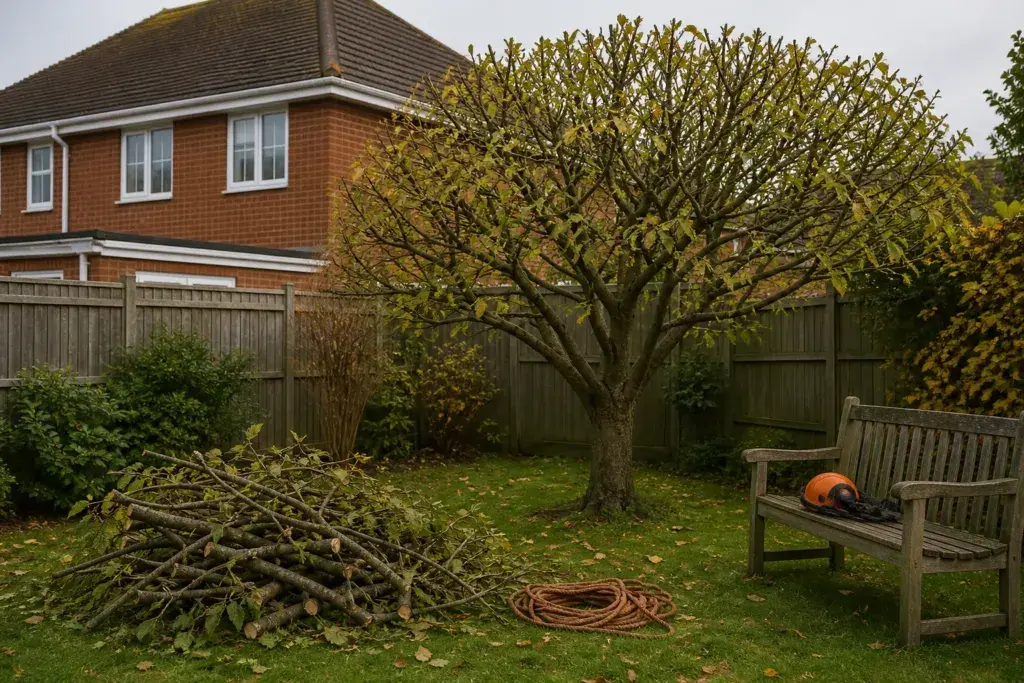
For homeowners and landowners in Leicestershire who want a tree made smaller without losing it, crown reduction is usually the job to ask for. It shortens branches across the whole canopy, so the tree comes down in both height and spread while keeping its natural outline. The work is done with small cuts made back to a suitable side branch. Crown thinning and crown lifting are useful jobs too. They solve different problems, though, and neither will bring a tree’s height down. A crown thin leaves the tree as tall as it was, and so does a crown lift to 4m.
Mixing up these terms is one of the easiest ways to end up with work you didn’t expect. This guide explains what each job involves, the limits that good pruning generally keeps to and which one suits which problem. It also covers how to check whether a tree is protected before anyone picks up a saw. With that in hand, a quote becomes much easier to read.
How a tree is made smaller with a reduction
A reduction works around the outer canopy. Each branch is either removed where it joins the tree or shortened back to a lateral. A lateral is a side branch growing out of the branch being cut. The lateral should be at least a third of the diameter of the piece being removed. That matters because the lateral becomes the new end of the branch, and it needs to be big enough to take over that job and keep growing in a healthy direction.
A quick example shows how the rule works in practice. If a limb is being shortened where it is 90mm thick, the side branch it is cut back to should be at least 30mm thick. Cut back to a thin twig instead, and the tree is left with a stub that has little to grow from.
All cuts are kept as small as possible. As a general rule, reduction cuts should not be more than 100mm across unless there is an overriding need. Smaller wounds give the tree a better chance of coping.
Topping is a different thing altogether, and it is harmful. It is an indiscriminate treatment that simply takes the top off a tree, with no thought for where each cut lands. A good reduction chooses every cut and keeps to the limits above. If anyone offers to top a tree to bring it down to size, treat that as a warning sign.
How it differs from crown thinning and crown lifting
Crown thinning removes a portion of the smaller branches, usually towards the outside of the crown, to even out how dense the foliage is. It lets more light and air through. Thinning is usually confined to broad-leaved trees, and the overall size and shape stay the same. The material taken out should stay within the percentage agreed for the job and should never be more than 30% overall.
So a written quote for a 15% thin means roughly that share of the smaller growth comes out, spread evenly. A quote that talks about thinning half the canopy is well beyond what good practice allows.
Crown lifting removes lower branches to give clearance underneath. It should be kept to less than 15% of the live crown height (the part of the tree carrying leaves). It should also leave the crown making up at least two thirds of the tree’s total height. Both limits are easier to picture with numbers.
Take a 15m tree. Two thirds of that is 10m, so the crown should still fill at least the top 10m, leaving no more than 5m of clear trunk. If that same tree has 10m of live crown, a lift should take away less than 1.5m of it. A lift that goes past these limits leaves a long bare trunk with a small tuft on top. That is bad for the tree and does nothing for the way it looks.
The clearance for a lift is best described from a fixed point, such as “crown lift to give 5.5m clearance above ground level”. Picture a tree beside a drive where a van or delivery lorry keeps catching the lower branches. Measuring from the ground over the drive means everyone knows exactly where the lowest branch should end up. A vaguer instruction, such as “lift the crown a bit”, leaves too much open to interpretation.
Which job does your tree need?
Start with the problem you want solved.
If the tree has grown too tall, or is spreading over a roof, a boundary or a neighbour’s garden, that points towards a reduction. If the garden feels dark or the canopy has become very dense, thinning may be enough. Where the issue is headroom over a driveway, footpath or road, a lift to a stated clearance is usually the answer. Some trees need a mix of two of these, carried out at the same visit.
Some trees suit an older approach. Coppicing means cutting a tree down to within 300mm (12in) of the ground at regular intervals and letting it regrow from the base. It has traditionally been used for species such as hazel and sweet chestnut. On a smallholding or along a field edge, it can be a practical way to keep these trees productive and in check, and the regrowth can be cut again on a regular cycle.
Sometimes no pruning job will fix the problem. The tree may be too close to a building, or in poor health. In that case a proper assessment may point towards planned, safe removal. That decision is best made calmly, by a qualified arborist who can judge the tree standing in front of them.
Roots matter too. Root pruning, for example to make way for a path, wall or extension, can affect a tree’s stability, so get professional advice before any roots are cut. The same applies to builders planning foundations or service trenches near retained trees.
Common pruning mistakes to avoid
A few long-standing habits still turn up in gardens. Some do more harm than good.
Painting or sealing pruning cuts is one. It brings no benefit and may be harmful. Timber treatments should not be used on a living tree either, because they harm living cells. A clean cut in the right place, left to close on its own, is the best thing you can give a tree.
Knocking off fungal brackets is another. Removing the fruiting body (the visible bracket or mushroom) will not stop the fungus spreading further through the tree. It also makes it harder for an arborist to work out what the fungus is and how the tree is likely to fare. If a bracket appears on a trunk or at the base of a tree, leave it where it is and have the tree looked at.
Feeding a tree is often done with good intentions. Fertiliser will only help if a nutrient shortage has actually been confirmed, so it will not cure a tree that simply looks tired. Finding the real cause first saves money and effort.
Check whether your tree is protected before any pruning
Permission rules cover pruning as well as felling. Leicester City Council says trees are protected if they are covered by a Tree Preservation Order (TPO) or stand in a conservation area. In a conservation area, protection applies automatically to any tree with a trunk more than 75mm in diameter, measured 1.5m above the ground.
That is a slim trunk. If you have a tape measure rather than callipers, 75mm across works out at roughly 24cm around the trunk. Plenty of young garden trees and established hedgerow trees will pass that mark.
There are over 450 TPOs across Leicester. Among the protected trees is a historic avenue of Wellingtonias, which the council manages under a tree preservation strategy called Pine Tree Avenue. The council says permission is needed to cut down, top, lop or prune a protected tree, and to carry out any work on any tree in a conservation area. Those older words still matter. “Lopping” and “topping” are generally regarded as outdated terms in tree work, but they remain in planning legislation, so a light trim still counts.
The council states that carrying out work on a protected tree without permission is an offence. Felling or pruning a protected tree without consent from the local planning authority may be treated as a criminal matter. The council aims to investigate reports of unauthorised work within a working day.
Checking is straightforward. The council’s interactive map shows whether a TPO applies to a tree and whether the tree sits in a conservation area. If permission is needed, there is no fee to apply. Applications are made through the Planning Portal. Elsewhere in Leicestershire, check with your own local planning authority, because each council keeps its own records. This is general guidance and not legal advice, and the details of any particular case are for the council to confirm.
Protection can work the other way, too. If you value a tree in your neighbourhood, anyone can ask Leicester City Council to protect it with a TPO. Email [email protected] with your reasons and a sketch map showing where the tree stands in relation to nearby buildings or roads. Or write to the Planning Officer (Trees), Planning Service, Leicester City Council, 115 Charles Street, Leicester, LE1 1FZ.
What to ask for before work starts
The most useful thing to ask for is a written specification. It should name the type of work and the figures that go with it: a reduction in height and spread, a thin of a stated percentage, or a lift to a fixed clearance above the ground. With that in writing, everyone knows what the finished tree should look like. Checking the result is then easy.
BS3998: 2010 Recommendations for Tree Work is one of the British Standards most relevant to this kind of work. It is reasonable to ask a tree surgeon whether the job will follow recognised good practice. Builders, developers and site managers will also come across BS5837: 2012 Trees in Relation to Design, Demolition and Construction, which deals with trees on and around building sites. On a development or site clearance job, plan any pruning or removal around that guidance from the start. Leaving it until the groundwork has begun usually makes everything harder.
Leicester City Council says it cannot recommend specific tree surgeons. It points instead to the Arboricultural Association, which keeps a list of approved contractors. Whoever you choose, a written specification and a check on protection are sensible starting points.
Keeping a tree that has outgrown its space
A tree that has grown too big does not always have to go. Crown reduction, done properly and within sensible limits, can keep a well-loved tree in the garden for years while easing the problems it causes. For anyone in that position, the message is simple: decide what you want the work to achieve, check the council’s map for protection, and get the specification in writing. Those principles guide good tree work on large estates and public land, and they apply just as much to the tree at the end of your own garden or along your own boundary.
If you have a tree you are unsure about, Harbour Tree Care is happy to take a look and talk you through your options.