After Storm Austen, a calm guide for Leicestershire property owners on keeping safe around a fallen or split tree, recording the damage and getting the removal planned properly.
If a storm brings down or damages a tree on your property, keep people and pets away from it and stay well clear of any power lines it touches. Don’t climb it or cut into it yourself. Take photos from a safe distance, then ask a qualified tree surgeon to look at the tree before anything is moved. That short list covers most of what a homeowner needs to do in the first few hours after storm damage.
This guide follows the Met Office naming Storm Austen in October 2026, the first named storm of the autumn. Leicestershire sat outside the yellow wind warning, but blustery weather and heavy rain were forecast much more widely, and further unsettled spells were expected to follow. Trees across the county may still be tested over the coming weeks, so it helps to know what to do before you need to.
What to do in the first hour after a tree comes down
Power lines come first. When it named the storm, the Met Office warned of travel disruption, power cuts and injuries from debris in places. A tree that has fallen across a cable, or is leaning on one, should be treated as live. Report it to your electricity network operator and let them make it safe before anyone else goes near.
Photos are more useful when they are thorough. A few clear pictures of the whole tree, the base, any broken limbs and anything it has landed on give you a record to share with your insurer or a neighbour. They also help a tree surgeon understand the job before arriving. Choose a spot to take them from where nothing can shift onto you.
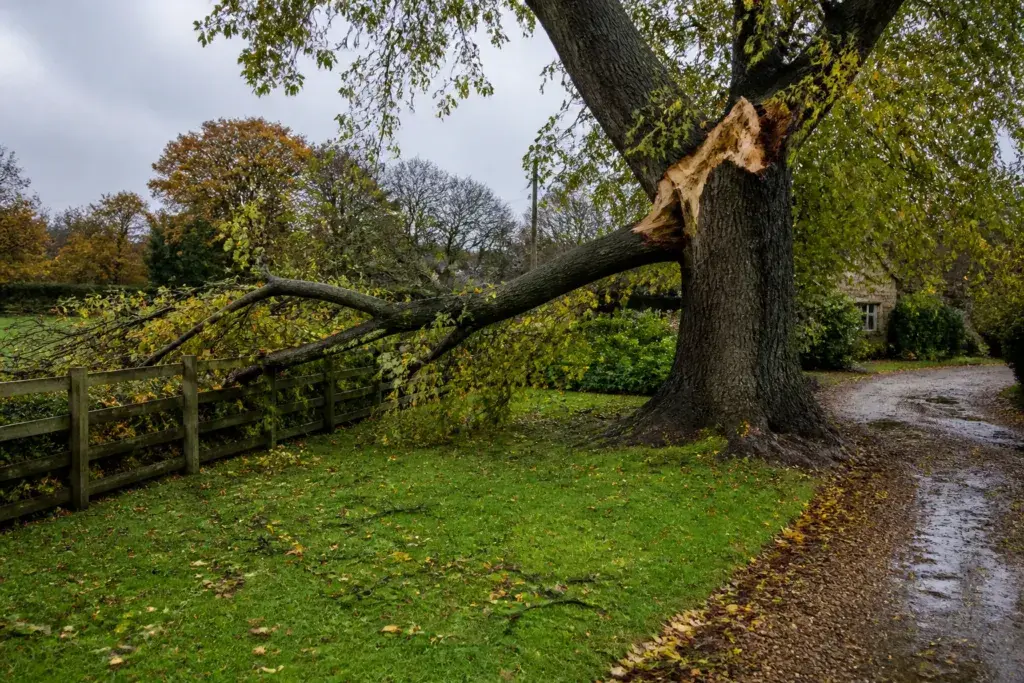
The reason for leaving the saw in the shed is tension. Fallen and split timber is often loaded, a bit like a bent spring. A trunk pinned at one end or a limb twisted against the ground can move suddenly and with real force when it is cut in the wrong place. Storm work is best handled by someone trained to read how the wood is loaded.
What Storm Austen means for trees in Leicestershire
According to BBC Weather, Storm Austen was a rapidly deepening area of low pressure approaching from the Atlantic from late Thursday, set to bring severe gales and heavy rain to parts of the UK. The Met Office explained that the low formed in the Atlantic and deepened quickly as it was invigorated by the jet stream. Tuesday and Wednesday were forecast to bring spells of rain and showers for many, before attention shifted to the south-west of the UK late on Thursday as the storm began its approach.
The Met Office yellow warning for wind ran from midnight on Friday to 12:00 BST and covered south Wales, south-west England and southern coastal counties of England. BBC Weather reported that damage to buildings and transport disruption was likely in that area, with the possibility of power cuts. Gusts of up to 70mph were expected in the warning area, with 50-60mph felt more widely around west Wales and through southern England. Tom Crabtree, Met Office Deputy Chief Forecaster, said: “Peak gusts in excess of 70mph are possible on the most exposed coastal areas, while 50-60mph are likely more widely within the warning area.”
Leicestershire was outside that area, and Scotland and Northern Ireland were expected to largely miss the impacts. Even so, the forecast was for the rest of England and Wales to stay blustery, with heavy rain at times, after the strongest winds eased from the south-west on Friday morning. Mr Crabtree was also clear that the details could shift: “While the exact track and position of Storm Austen is still being determined, what’s clear is that we have an impactful period of weather on the way and the potential for disruption in places, which has resulted in the system being named.”
For homeowners here, the practical reading is that a storm doesn’t have to bring the headline gusts to cause problems. A mature tree that is already carrying a weak limb, or growing in waterlogged soil, may give way in winds well below warning level.
Why heavy rain matters as much as the wind
The Met Office expected 20-30mm of rain in many places on Friday, with higher totals possible over higher ground in the west and further north. Winds had been strengthening from Wednesday, with heavy rain across the UK over several days, and further periods of wind and rain were likely through the weekend and into the start of the following week, with the heaviest rain more likely in western areas.
That matters because of the root plate. This is the wide, fairly shallow disc of roots and soil that anchors a tree, a bit like the base of a parasol. When the ground is firm, it holds well. When the soil is soaked and soft, the root plate can shift more easily under the same wind load, and a tree that has stood for decades may start to lean.
Most trees cope perfectly well with a wet autumn, so there’s no need to worry about every tree in the garden. The signs worth reporting are a new lean, soil or turf that has lifted or cracked on one side of the trunk, and cracks or splits at the base. If you notice any of these after heavy rain, a proper assessment is a sensible next step.
Which storm damage can wait and which needs a tree surgeon soon
Not everything needs attention straight away. Small twigs, leaves and light debris on a lawn can usually wait until the weather settles, and many homeowners clear these themselves.
Other damage is worth getting looked at promptly:
- branches that have snapped but are still hanging in the canopy (often called hung-up or hanging branches)
- split or torn stems, where the trunk or a main limb has opened up
- trees resting on a house, garage, fence or vehicle
- trees or limbs lying across a road, path or driveway, or onto a neighbour’s land
Timing helps too. The Met Office forecast Storm Austen to move from west to east through Friday, with winds generally easing later in the day before it cleared into the North Sea. BBC Weather said a quiet spell with clear skies would follow overnight into Saturday. Nobody should be working near a damaged tree while the strongest winds are still blowing. A calmer window like that is the time to get the tree assessed, before the next windy spell arrives.
How we plan the safe removal of a storm-damaged tree
Safe tree removal is the work we’re proudest of, and storm jobs show why planning matters. Stump grinding and clearing up come once the tree itself is safely down.
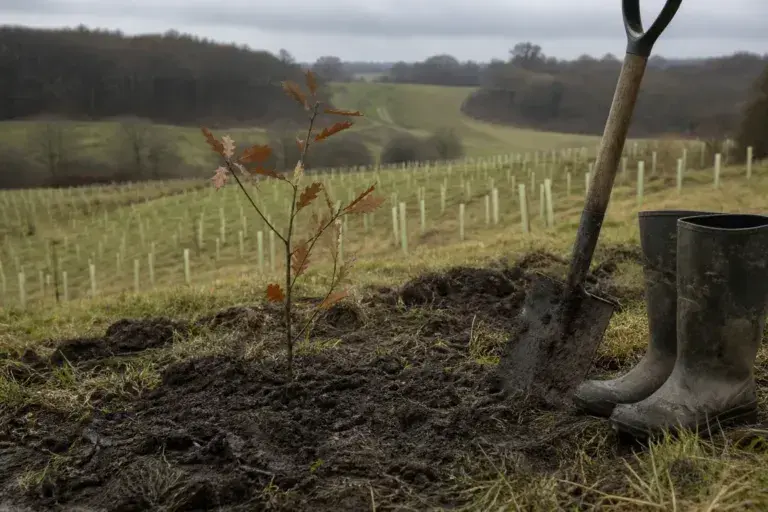
A proper assessment doesn’t always end in removal. A tree that has lost one limb may be perfectly sound otherwise, and careful pruning could leave it safe and still adding to the garden. Where a tree does have to come out, replacement planting with a suitable native species is worth thinking about once the ground has settled.
Checking your trees before the next spell of wind
The weather didn’t settle once Storm Austen moved away. BBC Weather reported that another deep low, not expected to be as severe and unlikely to be named, would head towards Scotland at the start of the weekend. Gusts of 70-80mph were forecast for western Scotland, with delays or cancellations to ferries and restrictions on bridges. Elsewhere it was expected to turn windy across the UK on Saturday, with heavy rain spreading east for most. Sunday was forecast to be drier but still very windy, particularly towards the north east of Scotland.
A calm, dry day is a good time for a walk round your property. Look up into the canopy for deadwood (dead branches, often bare, grey or missing bark) and cracked limbs. Pay most attention to trees that overhang drives, paths, parking areas and boundaries, since those are where a falling branch would cause the most trouble. On a smallholding or larger plot, roadside trees and those on steep banks deserve a closer look.
It also pays to keep an eye on the forecast. As Tom Crabtree put it, “Weather warnings are under constant review and could be updated as confidence increases, so it’s important to stay up-to-date with the forecast in the coming days.”
For Leicestershire property owners, the message is simple: check your trees on a calm day, watch for a new lean or lifted soil after heavy rain, and get split stems or hanging branches assessed before the next windy spell. Storm Austen’s strongest winds may have fallen further south, but the same practical steps apply to the trees around your own home. If you’d like a tree looked at, before or after the next spell of wind, the Harbour Tree Care team is always happy to help.